Meet the sweet team:
, and
Different ingredients bring sweetness.

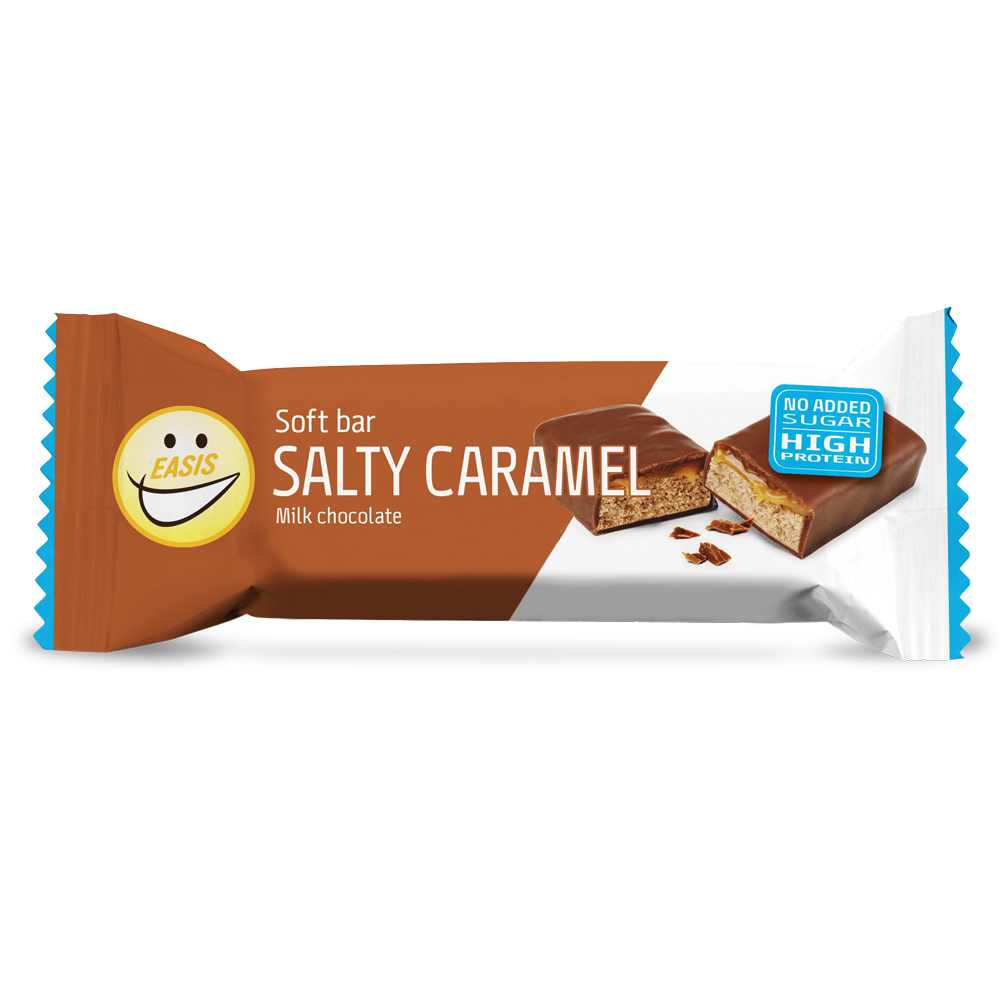
EASIS Denmark
1 bar (30 g)
Flip. Play. Know me.
0/4 cards explored
Rewards pending—points are not credited yet. Saving or claiming operational Your Radiant Points requires a Your Radiant account.
Bulking agent (polydextrose), MILK PROTEIN, hydrolysed collagen, vegetable fat (palm), cocoa butter, humectant (glycerol), SOYA FLOUR, sweetener (erythritol) (4.3%), dietary fibre (inulin), colour (calcium carbonate), SKIMMED MILK POWDER, dietary fibre (oligofructose), cocoa mass, WHOLE MILK POWDER, vegetable oil (SOYA), SOYA PROTEIN, soluble corn fibre, salt, emulsifier (SOYA LECITHIN), reduced-fat cocoa powder, flavourings, sweeteners (sucralose, steviol glycosides from stevia).
Allergens are shown in CAPITAL LETTERS, as on the brand label.
Allergens: MILK, SOYA
May contain: Egg, Gluten, Nuts, Peanuts, Sesame
Contains sweeteners. No added sugar; contains naturally occurring sugars.
Excessive consumption may produce laxative effects.
| Energy | 1411 kJ / 337 kcal |
|---|---|
| Fat | 19 g |
| of which saturates | 9.1 g |
| Carbohydrate | 16 g |
| of which sugars | 6.3 g |
| of which polyols | 10 g |
| Fibre | 28 g |
| Protein | 20 g |
| Salt | 1.1 g |
Per 1 bar (30 g) · EU adult Reference Intake
Fibre: 8.4 g. No EU legal RI exists for fibre.
RI of an average adult (8400 kJ / 2000 kcal), EU Regulation 1169/2011 Annex XIII. A reference, not a health score, target or safety limit. Unit values are calculated from the label and rounded.
Legal product information is the brand's own labelling. Matched to the brand's own product page — not independently verified by Sureka Official source ↗
Ingredient origin and processing explanations are general science, not verified supplier provenance. Sureka explains, never scores, ranks or recommends, and gives no dietary advice.
It is made from glucose, a simple sugar usually taken from starch such as corn or wheat.
Glucose is heated with a little sorbitol and citric acid until the pieces link into long, branched chains your body mostly can't digest.
Used to replace the bulk that is lost when sugar is removed, and to raise fibre content.
It's on this label as “Bulking agent (polydextrose)” (ingredient 1 of 12 linked). The brand doesn't say exactly what job it does in this product, so Dotfly won't guess.
Wikipedia — Polydextrose ↗From cow's milk.
Milk is filtered or separated so the protein part is kept and much of the water, fat and milk sugar is removed, then dried to a powder.
Used to raise protein content and to build the chewy body of protein bars.
It's on this label as “MILK PROTEIN” (ingredient 2 of 12 linked). The brand doesn't say exactly what job it does in this product, so Dotfly won't guess.
Wikipedia — Milk protein concentrate ↗Collagen is a protein from animal connective tissue, skin or bones (for example cattle, pigs or fish).
The collagen is broken into smaller pieces with water and enzymes (that's what "hydrolysed" means), then dried.
Used to add protein without thickening the recipe the way other proteins do.
It's on this label as “Hydrolysed collagen” (ingredient 3 of 12 linked). The brand doesn't say exactly what job it does in this product, so Dotfly won't guess.
Wikipedia — Hydrolyzed collagen ↗From cocoa beans, the seeds of the cacao tree.
Beans are fermented, dried and roasted, ground into a paste, and the paste is pressed to squeeze out the fat.
Used to give chocolate its snap, gloss and the way it melts in the mouth.
It's on this label as “Cocoa butter” (ingredient 4 of 12 linked). The brand doesn't say exactly what job it does in this product, so Dotfly won't guess.
Wikipedia — Cocoa butter ↗Glycerol is part of every fat and oil, from plants or animals.
It is usually split off from fats and oils and then purified into a clear, slightly sweet liquid.
Used to keep bars soft over shelf life by holding on to moisture.
It's on this label as “Humectant (glycerol)” (ingredient 5 of 12 linked). The brand doesn't say exactly what job it does in this product, so Dotfly won't guess.
Wikipedia — Glycerol ↗Found naturally in small amounts in some fruits and fermented foods.
For food use it is usually made by fermentation: microbes are fed glucose and turn it into erythritol, which is then purified.
Used as a bulk sweetener, often combined with high-intensity sweeteners to balance the taste profile.
It's on this label as “Sweetener (erythritol) (4.3%)” (ingredient 6 of 12 linked). The brand doesn't say exactly what job it does in this product, so Dotfly won't guess.
Wikipedia — Erythritol ↗From the root of the chicory plant, a relative of the dandelion.
The roots are chopped and soaked in hot water, which pulls out the fibre (inulin), then it is cleaned and dried.
Used to add fibre and a light sweetness, and to give body to bars, spreads and drinks.
It's on this label as “Dietary fibre (inulin, oligofructose)” (ingredient 7 of 12 linked). The brand doesn't say exactly what job it does in this product, so Dotfly won't guess.
Wikipedia — Inulin ↗From cow's milk.
Milk is concentrated and then sprayed into hot air so the water evaporates and a powder is left.
Used in milk chocolate for creaminess, colour and a milder cocoa taste.
It's on this label as “SKIMMED MILK POWDER, WHOLE MILK POWDER” (ingredient 8 of 12 linked). The brand doesn't say exactly what job it does in this product, so Dotfly won't guess.
Wikipedia — Powdered milk ↗From cocoa beans, the seeds of the cacao tree.
Fermented, dried and roasted beans are shelled and ground until the fat melts into a thick, dark paste.
Used as the flavour and colour base of dark and milk chocolate, and as a carrier for cocoa butter.
It's on this label as “Cocoa mass” (ingredient 9 of 12 linked). The brand doesn't say exactly what job it does in this product, so Dotfly won't guess.
Wikipedia — Chocolate liquor ↗From soya beans.
It is separated out while soya bean oil is being cleaned, then dried.
Used in chocolate to help fat and solids flow together, which reduces the amount of cocoa butter needed.
It's on this label as “Emulsifier (SOYA LECITHIN)” (ingredient 10 of 12 linked). The brand doesn't say exactly what job it does in this product, so Dotfly won't guess.
Wikipedia — Lecithin ↗From cocoa beans, the seeds of the cacao tree.
After most of the cocoa butter is pressed out of cocoa paste, the dry cake that's left is ground into powder.
Used to add cocoa taste and colour where a low fat content is needed, for example in drinks and coatings.
It's on this label as “Reduced-fat cocoa powder” (ingredient 11 of 12 linked). The brand doesn't say exactly what job it does in this product, so Dotfly won't guess.
Wikipedia — Cocoa solids ↗The stevia PLANT is a leafy shrub from South America. Steviol glycosides are the sweet compounds in its leaves — and in the EU they are an authorised food additive (E 960), not the leaf itself.
In general they are extracted from dried leaves with water and purified; other authorised production methods also exist. This label does not say how its supplier made them.
Used in very small amounts to add sweetness without adding bulk or energy.
It's on this label as “Sweeteners (sucralose, steviol glycosides from stevia)” (ingredient 12 of 12 linked). The brand doesn't say exactly what job it does in this product, so Dotfly won't guess.
Wikipedia — Steviol glycoside ↗