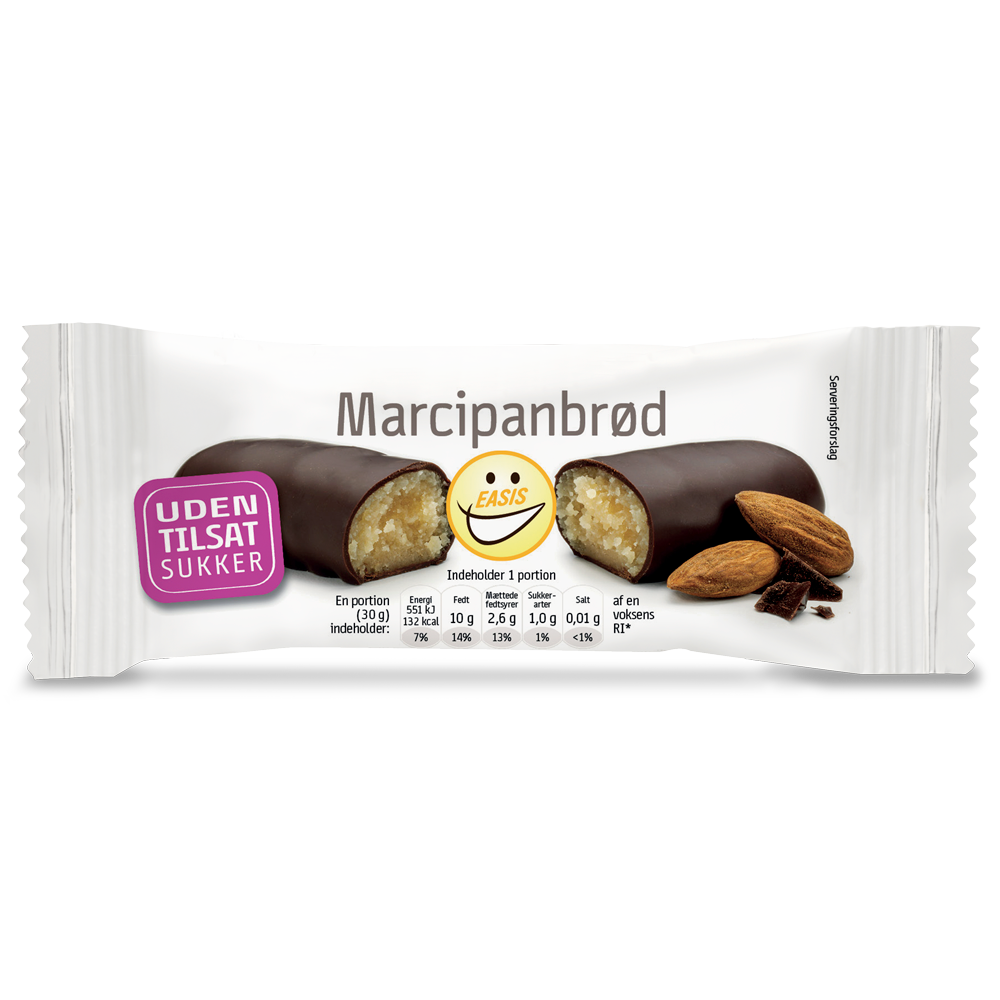
EASIS Marzipan Bar — 30 g
01 · A Little Bit
EASIS 🇩🇰
EASIS Marzipan Bar — 30 g
Classic marzipan coated in dark chocolate. A compact indulgent snack with no added sugar and a high fibre content.
A sweet treat with more fibre than sugar… really?
02 · A Little Bit More
Really! One bar has 7.8 g of fibre and 1 g of sugars.
In one 1 bar (30 g) (one you'd eat, not a wholesale case)
- Energy
- 522 kJ / 125 kcal
- Fat
- 9.6 g
- of which saturates
- 2.5 g
- of which sugars
- 1 g
Dotfly: these are the label numbers for the serving shown above. Open the full table below for every value.
Curious about all the numbers?
Per 1 bar (30 g) · % of EU adult Reference Intake
- Energy522 kJ / 125 kcal6%EU RI 8400 kJ / 2000 kcal
- Fat9.6 g14%EU RI 70 g
- of which saturates2.5 g13%EU RI 20 g
- Carbohydrate5.1 g2%EU RI 260 g
- of which sugars1 g1%EU RI 90 g
- Protein3 g6%EU RI 50 g
- Salt0.01 g<1%EU RI 6 g
- Fibre7.8 gDeclared amount only. No EU Reference Intake exists for fibre; for context, EFSA's adult Adequate Intake is 25 g/day (an EFSA scientific value, not an EU legal RI).
Reference Intake (RI) of an average adult (8400 kJ / 2000 kcal), EU Regulation 1169/2011 Annex XIII — a reference amount, not a health score, target or safety limit. Per-unit values are calculated from the label per-100 g values and the stated unit size, and rounded.
Full declared nutrition · per 100 g
| Energy | 1739 kJ / 416 kcal |
|---|---|
| Fat | 32 g |
| of which saturates | 8.4 g |
| Carbohydrate | 17 g |
| of which sugars | 3.2 g |
| of which polyols | 6.9 g |
| Fibre | 26 g |
| Protein | 10 g |
| Salt | 0.03 g |
Raw declared values. No Low/Medium/High bands, scores or comparisons. Source: Matched to the brand's own product page — not independently verified by Sureka · brand page.
03 · A Little Bit More Fun
The label names erythritol and steviol glycosides (sweet compounds from the stevia plant). It also says no added sugar — the sugars that are there occur naturally in the ingredients.
Dotfly: psst — tap a card to discover its answer.
“Where from” and “how made” are general food science about each ingredient type — not how this brand's supplier made it.
AlmondsWhere does almonds come from?Tap to discoverTap to close
Cocoa massHow is cocoa mass made?Tap to discoverTap to close
PolydextroseWhy is polydextrose in a treat like this?Tap to discoverTap to close
All ingredient stories
Almonds
Where does it come from? Almonds are the seeds of the almond tree's fruit.
How is it made? They are harvested, shelled and often blanched (skins removed) before grinding.
Why is it needed? Used for crunch, fat and flavour in snacks and coatings.
What does it do here? It's on this label as “ALMONDS (41%)” (ingredient 1 of 11 linked). The brand doesn't say exactly what job it does in this product, so Dotfly won't guess.
Wikipedia — AlmondCocoa mass
Where does it come from? From cocoa beans, the seeds of the cacao tree.
How is it made? Fermented, dried and roasted beans are shelled and ground until the fat melts into a thick, dark paste.
Why is it needed? Used as the flavour and colour base of dark and milk chocolate, and as a carrier for cocoa butter.
What does it do here? It's on this label as “Cocoa mass” (ingredient 2 of 11 linked). The brand doesn't say exactly what job it does in this product, so Dotfly won't guess.
Wikipedia — Chocolate liquorWater
Where does it come from? Drinking-quality water.
How is it made? Used as it is.
Why is it needed? Used to dissolve, dilute and control texture and water activity.
What does it do here? It's on this label as “Water” (ingredient 3 of 11 linked). The brand doesn't say exactly what job it does in this product, so Dotfly won't guess.
Wikipedia — WaterPolydextrose
Where does it come from? It is made from glucose, a simple sugar usually taken from starch such as corn or wheat.
How is it made? Glucose is heated with a little sorbitol and citric acid until the pieces link into long, branched chains your body mostly can't digest.
Why is it needed? Used to replace the bulk that is lost when sugar is removed, and to raise fibre content.
What does it do here? It's on this label as “Bulking agent (polydextrose)” (ingredient 4 of 11 linked). The brand doesn't say exactly what job it does in this product, so Dotfly won't guess.
Wikipedia — PolydextroseChicory root fibre (inulin)
Where does it come from? From the root of the chicory plant, a relative of the dandelion.
How is it made? The roots are chopped and soaked in hot water, which pulls out the fibre (inulin), then it is cleaned and dried.
Why is it needed? Used to add fibre and a light sweetness, and to give body to bars, spreads and drinks.
What does it do here? It's on this label as “Dietary fibre (oligofructose, inulin)” (ingredient 5 of 11 linked). The brand doesn't say exactly what job it does in this product, so Dotfly won't guess.
Wikipedia — InulinErythritol
Where does it come from? Found naturally in small amounts in some fruits and fermented foods.
How is it made? For food use it is usually made by fermentation: microbes are fed glucose and turn it into erythritol, which is then purified.
Why is it needed? Used as a bulk sweetener, often combined with high-intensity sweeteners to balance the taste profile.
What does it do here? It's on this label as “Sweetener (erythritol, 6.9%)” (ingredient 6 of 11 linked). The brand doesn't say exactly what job it does in this product, so Dotfly won't guess.
Wikipedia — ErythritolCocoa butter
Where does it come from? From cocoa beans, the seeds of the cacao tree.
How is it made? Beans are fermented, dried and roasted, ground into a paste, and the paste is pressed to squeeze out the fat.
Why is it needed? Used to give chocolate its snap, gloss and the way it melts in the mouth.
What does it do here? It's on this label as “Cocoa butter” (ingredient 7 of 11 linked). The brand doesn't say exactly what job it does in this product, so Dotfly won't guess.
Wikipedia — Cocoa butterCocoa powder
Where does it come from? From cocoa beans, the seeds of the cacao tree.
How is it made? After most of the cocoa butter is pressed out of cocoa paste, the dry cake that's left is ground into powder.
Why is it needed? Used to add cocoa taste and colour where a low fat content is needed, for example in drinks and coatings.
What does it do here? It's on this label as “Reduced-fat cocoa powder” (ingredient 8 of 11 linked). The brand doesn't say exactly what job it does in this product, so Dotfly won't guess.
Wikipedia — Cocoa solidsSoy lecithin
Where does it come from? From soya beans.
How is it made? It is separated out while soya bean oil is being cleaned, then dried.
Why is it needed? Used in chocolate to help fat and solids flow together, which reduces the amount of cocoa butter needed.
What does it do here? It's on this label as “Emulsifier (SOYA LECITHIN)” (ingredient 9 of 11 linked). The brand doesn't say exactly what job it does in this product, so Dotfly won't guess.
Wikipedia — LecithinSteviol glycosides
Where does it come from? The stevia PLANT is a leafy shrub from South America. Steviol glycosides are the sweet compounds in its leaves — and in the EU they are an authorised food additive (E 960), not the leaf itself.
How is it made? In general they are extracted from dried leaves with water and purified; other authorised production methods also exist. This label does not say how its supplier made them.
Why is it needed? Used in very small amounts to add sweetness without adding bulk or energy.
What does it do here? It's on this label as “Steviol glycosides” (ingredient 10 of 11 linked). The brand doesn't say exactly what job it does in this product, so Dotfly won't guess.
Wikipedia — Steviol glycosideVanilla extract
Where does it come from? From the pods of a climbing vanilla orchid.
How is it made? The pods are cured and dried, then soaked in a liquid (often alcohol and water) that pulls out the flavour.
Why is it needed? Used to round off cocoa and dairy notes.
What does it do here? It's on this label as “Natural vanilla flavouring” (ingredient 11 of 11 linked). The brand doesn't say exactly what job it does in this product, so Dotfly won't guess.
Wikipedia — Vanilla extractFull ingredient list, allergens & label info
Ingredient declaration (brand label)
ALMONDS (41%), cocoa mass, water, bulking agent (polydextrose), dietary fibre (oligofructose), sweetener (erythritol, 6.9%), cocoa butter, dietary fibre (dextrin), dietary fibre (inulin), reduced-fat cocoa powder, emulsifier (SOYA LECITHIN), preservative (potassium sorbate), sweeteners (sucralose, steviol glycosides), natural vanilla flavouring.
Allergens are shown in CAPITAL LETTERS, as on the brand's label.
Brand / label information
Contains sweeteners. No added sugar, but contains naturally occurring sugars.
Legal product information is the brand's own labelling. Matched to the brand's own product page — not independently verified by Sureka · brand page.
Little Discovery
What turns marzipan into a smooth, rich paste?
Thanks for Your Understanding
A Little Bit. A Little Bit More. A Little Bit More Fun. Your Radiant is where rewards for discoveries like this will live.
Answer Little Discovery correctly to unlock your Your Radiant link.
Reward pending — points are not credited yet.